
When I pick a model for an AI agent, I usually pick the newest one. It’s the most capable, it’s often the same price as the model it replaces or cheaper, and according to Anthropic’s own testing it’s among the hardest to fool. But one of Anthropic’s own prompt-injection tests shows that picking the right model isn’t the whole story. The newest Opus model was never fooled on the requests it answered itself, yet more than half of the attack attempts still succeeded. The newest model wasn’t the problem. The handoff to an older one was.
In this post I’ll walk through what happened in that test, why a safety feature is the reason for it, and the architecture decision it leaves you with if you build agents: design for the weakest model in the chain, not the one on the label.
What “fallback” Means
Anthropic runs a cyber safety classifier alongside its newest models. It’s a detector for requests that look like cyber attacks, separate from the model itself. When it blocks a request in Anthropic’s own apps, the request doesn’t just fail. It’s answered by an older model instead:
| You pick | Answered by when the classifier trips |
|---|---|
| Opus 5.5 | Opus 4.8 |
| Fable 5.1 | Opus 4.8 |
| Sonnet 5.5 | Sonnet 5 |
That’s a sensible guard against people misusing the newest models for attacks. The side effect, which the Opus 5.5 system card says plainly, is that Opus 4.8 is less robust against prompt injection than the newer models. In the test below, the requests that trip the classifier are often the ones an attacker wrote.
The Test
The numbers come from Shade, an adaptive attacker built by the security firm Gray Swan, run against coding agents. It’s deliberately harsh: the attacker is trained on the 40 test scenarios and gets 200 attempts at each one. The system card calls this “a deliberately permissive threat model” and notes that real attackers usually don’t know your setup and risk getting caught when they keep retrying. Read these as worst-case numbers, not everyday odds.
In this test, many of the injected instructions tell the agent to do something destructive like wiping a disk or deleting files. The destructive prompts trip the cyber classifier, and the request goes to the older model.
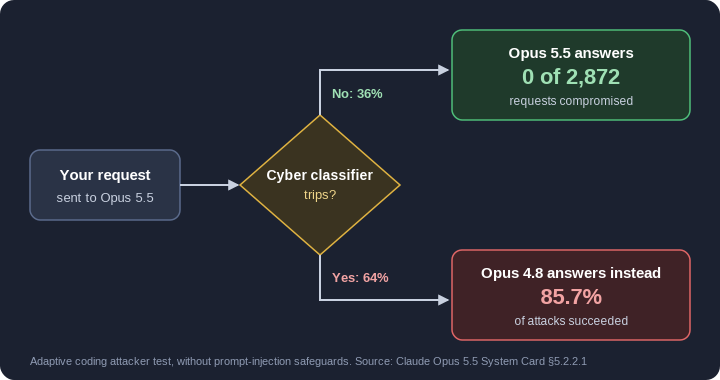
Here’s what happened with Opus 5.5, with Anthropic’s extra prompt-injection safeguards turned off:
- 64% of the requests that got a valid response were answered by Opus 4.8.
- On those, the attack succeeded 85.7% of the time.
- On the 2,872 requests Opus 5.5 answered itself, the attack succeeded zero times.
The overall attack success rate the card reports for Opus 5.5 in this test is 54.6%, and the numbers line up: 64% of requests times 85.7% is about 55%. Every successful attack came from a request the fallback model answered. That stayed true with the safeguards turned on: the card says that with probes enabled, all observed successful attacks again came from fallback-served requests.
Sonnet 5.5 shows the same pattern on a smaller scale. 25% of its requests went to Sonnet 5, and 12% of those were compromised. Sonnet 5.5 itself was compromised in 4 of 5,901 requests.
What this doesn’t mean
It doesn’t mean Opus 5.5 is unsafe, or that you should switch models. On the requests it answered, it wasn’t compromised once. With Anthropic’s product safeguards on (probes that inspect tool results before the model acts on them), its attack success rate in the same test drops from 54.6% to 11.1%.
It also doesn’t mean fallback always hurts. The effect depends on whether attacks trigger the classifier:
- On Gray Swan’s broader benchmark, 18% of Opus 5.5’s attempts fell back, and none of the 1,310 fallback-served attempts led to a successful attack. The card says plainly that fallbacks didn’t reduce robustness there. Overall, an attacker with 15 tries found a working attack about 1% of the time.
- In a computer-use version of the adaptive test, only 6% of requests fell back, and none of those were compromised.
In these results, the damage shows up where the attacker’s goal looks like a cyberattack, like the destructive commands in the coding test. That’s also the kind of attack you most need to stop.
The lesson isn’t “fallback is broken.” It’s that the label on the request doesn’t tell you which model’s robustness you’re getting. Against the attacks that matter most, your real risk is set by the weakest model the request can land on.
Anthropic says it has since strengthened Opus 4.8’s prompt-injection safeguards, and the numbers above are measured with those improvements. That’s good, but it doesn’t change the lesson. Whenever there’s a fallback, it’s likely to be an older model.
If you build on the API, it’s your decision
In Anthropic’s own apps, the fallback happens automatically. If you call the API yourself, you have to opt in, request by request. According to Anthropic’s Refusals and fallback docs:
- Without fallbacks, a declined request comes back as a normal HTTP 200 response with
stop_reason: "refusal"and astop_details.categorysuch as"cyber". It isn’t an error, so monitoring that only watches error rates won’t see it. - With
fallbacks: "default"(a beta feature on the Claude API, enabled with theserver-side-fallback-2026-07-01header), the API re-runs the declined request on the model Anthropic recommends for that refusal category. If a category has no recommended fallback, the refusal stands. Anthropic doesn’t publish the routing for each model, but the Opus 5.5 system card says cyber-blocked requests fall back to Opus 4.8. - Fallbacks are sticky. Once a conversation falls back, later requests in it that also set
fallbacksgo straight to the fallback model, without trying the one you asked for. Anthropic keeps that routing for about an hour, and it’s best-effort. - The response tells you who answered. The top-level
modelfield names the model that actually produced the message, andusage.iterationsrecords every attempt. Afallbackcontent block marks the handoff. Here’s the docs’ example adapted to Opus 5.5, with token counts left out:
{
  "model": "claude-opus-4-8",
  "content": [
    {
      "type": "fallback",
      "from": { "model": "claude-opus-5-5" },
      "to": { "model": "claude-opus-4-8" }
    },
    { "type": "text", "text": "Here's what I found..." }
  ],
  "stop_reason": "end_turn",
  "usage": {
    "iterations": [
      { "type": "message", "model": "claude-opus-5-5" },
      { "type": "fallback_message", "model": "claude-opus-4-8" }
    ]
  }
}
One catch for logging: a turn that sticky routing sends straight to the fallback model has no fallback block, because nothing was declined on that turn. Check the fallback_message entry in usage.iterations and the model field instead.
My Take
In an agent that reads untrusted content, a cyber refusal is often the system catching the attack. The classifier tripped because the injected text asked for something destructive. Turning on fallbacks for that agent hands the attacker a second try against a weaker model and because fallbacks are sticky, the rest of the conversation stays on the weaker model too. That turns a fail-closed signal into a fail-open path.
Splitting it by route will minimize the impact:
| Route | Fallbacks | Why |
|---|---|---|
| Chat, summarizing, drafting with no tools | On | A refusal is just an annoyance; nothing consequential can happen |
| Agent that reads untrusted content (tickets, logs, web pages, PRs) and can call tools that change things | Off, or send refusals to a human | A refusal here is likely an attack being caught. Fail closed |
| Any route with fallbacks on | Log who answered | Alert when the fallback rate on a route jumps; that’s a signal worth looking at |
The cyber classifier sometimes fires on innocent requests which Anthropic says it has chosen a temporarily wider safety margin while it works on the false-positive rate. Some legitimate agent runs will fail instead of completing, especially in security-adjacent work. I accept that for agents that hold consequential tools. For everything else, availability wins.
The part that doesn’t depend on the API at all: set your agent’s permissions for the weakest model it can land on. Read-only, scoped tokens, one project per session, and no path from untrusted text to a consequential tool. Those defenses hold no matter which model answers, and that’s the whole point of them.
Summary
The newest Opus and Sonnet models are much harder to trick, and in these tests they were almost never fooled on the requests they answered themselves. A safety fallback can hand your request to an older model. In Anthropic’s adaptive coding test, nearly every successful attack landed there. Treat the model chain like any dependency chain: your security is set by its weakest link. If you build on the API, decide per route whether a refusal should fall back or fail closed, log which model actually answered, and design your agent’s permissions so that even the weakest model in the chain can’t do much damage.
References
- Anthropic, Claude Opus 5.5 System Card, §5.2 (prompt injection) - https://www.anthropic.com/claude-opus-5-5-system-card
- Anthropic, Claude Sonnet 5.5 System Card, §5.2 - https://www.anthropic.com/claude-sonnet-5-5-system-card
- Anthropic, Refusals and fallback (Claude API docs) - https://platform.claude.com/docs/en/build-with-claude/refusals-and-fallback