
Ever wondered how to effectively mentor someone, or which mentoring approach would work best in your workplace? Mentoring is a powerful tool for growth, but there’s no one-size-fits-all solution. In this post, I’ll walk you through traditional and modern mentoring models, explore their key differences, and share practical strategies to overcome common challenges. The most important thing to remember is that mentoring only works when both the mentor and mentee are aligned on goals and communication styles. What works perfectly for one pair might not work for another. Whether you’re mentoring for the first time or looking to refine your approach, this guide will help you design a mentoring strategy that fits your organization and the people involved.
What is Mentoring?
Mentoring is the process of guiding someone through their growth by drawing on the experience of others within a shared context. It can be both a challenging and deeply rewarding journey and no two mentees are alike. That’s why it’s essential to open the relationship with a conversation around goals, so both the mentor and mentee are aligned on what they hope to achieve. Revisiting those goals periodically keeps the partnership on track and ensures the mentee continues to get real value from the relationship. The following best practices can help you navigate that process effectively:
Be the Person You Wish You Had
Remember what you were missing as a new employee? Provide those things for your mentee. You were in their position once, use that understanding to guide them.
Active Listening
Ask then listen. Active listening is one of the most important skills of being a mentor. Most of the time when someone needs help, all they really need is to discuss the problem they are facing. A lot of the time the mentee will be able to figure out the answers they are looking for just by talking it out. Other times, they may not be asking for what they really need. By using active listening skills, a mentor should be able to identify these situations and provide the help that's really needed.
Resourcefulness
It's okay not to have all the answers. What's more important is demonstrating your own process for finding solutions when you're stuck. Modeling this behavior builds self-sufficiency and productivity in their new role.
Common Challenges
Even the best mentoring relationships hit bumps along the way. Here are some of the most common ones to watch out for:
| Common Challenges | Description |
|---|---|
| Asking for Help | Mentees may hesitate to ask for help, even when they need it most. |
| Learning through Mistakes | Letting mentees work through mistakes on their own builds deeper understanding than jumping straight to the answer. |
| Learning and Growth Timeline | The mentoring relationship evolves over time. Recognizing when to adjust roles and expectations requires ongoing communication and flexibility. |
| Time | Conflicting schedules may limit availability and slow momentum. |
The challenges above don’t have a one-size-fits-all fix, but picking the right mentoring model can make a big difference. Below I’ll walk through traditional and modern mentoring, covering the highlights and trade-offs of each.
Traditional Mentoring
When most people hear the word “mentoring”, traditional mentoring is what comes to mind. In a workplace context, it typically involves a one-on-one relationship in which a seasoned employee guides someone newer to the role. Key characteristics include a mentor assigned by a manager or HR program, a defined start and end date, a structured process with set rules, in-person meetings, and a small, selective group of designated mentors.
While traditional mentoring is effective in many organizations, it comes with limitations. The model can only support a small number of mentoring relationships at a time, places the burden of all knowledge on a single person, and tends to reach only a fraction of employees. It can also be time-intensive and in some cases it may foster uneven or uncomfortable workplace dynamics. These limitations, alongside rapid technological advances, drove the evolution of the modern mentoring model.
Modern Mentoring
Modern mentoring is an open, collaborative approach to learning that brings people together in groups to share knowledge, exchange insights, and grow collectively. Unlike traditional mentoring, there are no fixed start or end dates. Individuals participate on their own terms, simply by joining group meetings and contributing to or drawing from discussions on relevant topics. Beyond learning, this format naturally fosters networking, giving participants the flexibility to break into smaller groups when more focused, one-on-one or small-group guidance is needed.
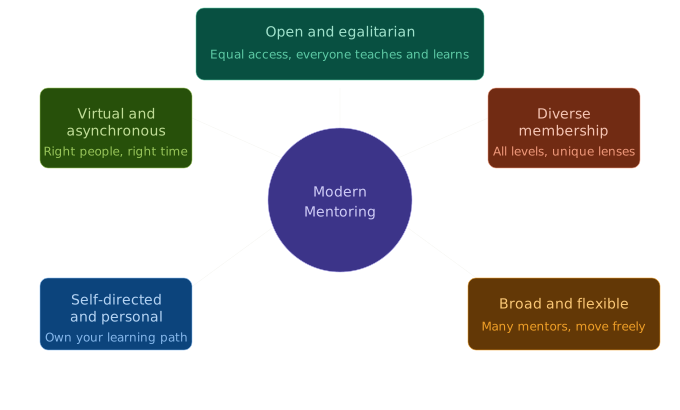
This model is built on five core concepts that enable the free flow of information and remove the rigid commitment associated with traditional one-on-one mentoring relationships. Together, these principles create an environment where employees can engage on their own schedule, stepping in and out as their availability and needs evolve.
Five Core Concepts of Modern Mentoring
Traditional vs Modern Mentoring
Now that you understand both approaches, let’s compare them directly. The table below highlights how traditional and modern mentoring differ in purpose, structure, and implementation.
| Mentoring Program | Traditional | Modern |
|---|---|---|
| Purpose | Career Advancement | Broad Learning |
| Participants | Mentors are senior leaders and proteges are high potential employees | Advisors and learners can be anyone in the organization |
| Connections | One to One | Many to Many |
| Duration | Long Term | As long as needed |
| Method | Face to Face | Virtual |
| Design | Top down and matched by outside administration | Flat and self Directed |
Summary
Mentoring is a powerful learning tool that requires the right approach for success. Traditional mentoring offers structured one-on-one relationships with clear hierarchies, while modern mentoring embraces collaborative, group-based learning with flexibility. Both have strengths—traditional mentoring provides focused guidance, whereas modern mentoring scales across organizations and removes rigid commitments. The key to effective mentoring lies in active listening, resourcefulness, and recognizing that every mentor-mentee relationship is unique. Success depends on choosing the model that best fits your organization’s culture, needs, and the specific dynamics of the people involved. By understanding these approaches and their trade-offs, you can design mentorship programs that genuinely support growth and development.
References
- On Mentoring By Ted Neward - http://www.codemag.com/article/1701111
- Modern Mentoring by Randy Emelo - https://www.amazon.com/Modern-Mentoring-Randy-Emelo/dp/1562869337